



IPSec vs. OpenVPN: Wat is het verschil?
With access to the largest NB-IoT, LTE-M, 4G, and fastest 5G networks, partnering with Simhuis can give you a competitive edge and help you increase your profitability.
Quick definition of IPSec vs. OpenVPN
IPSec and OpenVPN are both protocols for securing data transmission over a Virtual Private Network (VPN).
They both operate at the internet layer, and although it is often assumed that you can only use one of them, they can complement each other in some applications, such as the Internet of Things (IoT).
OpenVPN is a highly configurable open-source solution, while the Internet Security Protocol (IPSec) is defined by the Internet Engineering Task Force (IETF). Each protocol is best suited for specific circumstances, so it is worthwhile to understand how they work. Depending on your situation, you may have little choice between these solutions.
Hoe belangrijk zijn VPN's voor veilige gegevensoverdracht?
The more dispersed your devices or employees are, and the more valuable your data, the more important it becomes to encrypt and secure data transfer. Devices and users must have access to network resources without giving hackers a chance.
This is where IPSec and OpenVPN come into play. These protocol packages are two of the most widely used solutions for setting up a VPN. Within IoT, OpenVPN is an ideal choice for enabling remote access to IoT devices, for example, when a support engineer needs to connect to a device in the field using a laptop. IPSec, on the other hand, securely encrypts the data of an IoT device and provides access from an application.
In this article, we explore both solutions and their differences. Let's start with an overview of what these protocols do: create a VPN.
IPSec vs. OpenVPN
Wat is een VPN?
A Virtual Private Network (VPN) enables authorized users and devices to securely access company resources over public or private networks. A VPN creates an encrypted tunnel between networks, preventing outsiders from seeing the traffic.
Compare it to sending packages: a VPN is like your courier putting your package in a locked box with a different label on it, and only the intended recipient has the key. This makes it more difficult for others to gain access to the contents.
For example: if an employee accesses company applications from home or a café via a VPN, neighbors, housemates, or other café patrons cannot see what this employee is doing or intercept data.
In IoT, companies often have thousands of connected devices that need to communicate across various networks. Operators also frequently require access to individual devices to troubleshoot or implement updates. A VPN ensures that these IoT deployments can securely communicate with applications and infrastructure, regardless of their location. Because many IoT devices are not powerful enough to provide encryption themselves, companies often use an IoT gateway that connects to a VPN.
What is IPSec?
IPSec (Internet Security Protocol) comprises three protocols for securing network communication:
- Authentication Headers (AH): Verifies the identity of devices via a shared key and checks that data has not been modified.
- Encapsulating Security Payloads (ESP): Versleutelt datapunten, inclusief headers, en creëert nieuwe headers, zodat gegevens zonder de juiste sleutel onleesbaar zijn.
- ISAKMP (Internet Security Association and Key Management Protocol): Bepaalt hoe netwerkentiteiten communiceren, inclusief duur, versleutelingsmethodes en sleutels.
IPSec offers two modes:
- Transport mode: Secures only the content of data traffic.
- Tunnel mode: Creates an "always on" site-to-site VPN, allowing all IP addresses on both sides to communicate with each other.
What is OpenVPN?
OpenVPN is een open-source protocol dat UDP of TCP kan gebruiken voor gegevensoverdracht. Het biedt standaard 256-bits encryptie, maar kan worden geconfigureerd voor 128-bits encryptie. Dankzij zijn open-source karakter wordt OpenVPN voortdurend verbeterd door een wereldwijde gemeenschap.
Within IoT, OpenVPN functions as an on-demand point-to-point VPN, requiring users to authenticate via a username, password, or token. The protocol creates an encrypted tunnel between specific IP addresses and devices.
Differences between IPSec and OpenVPN
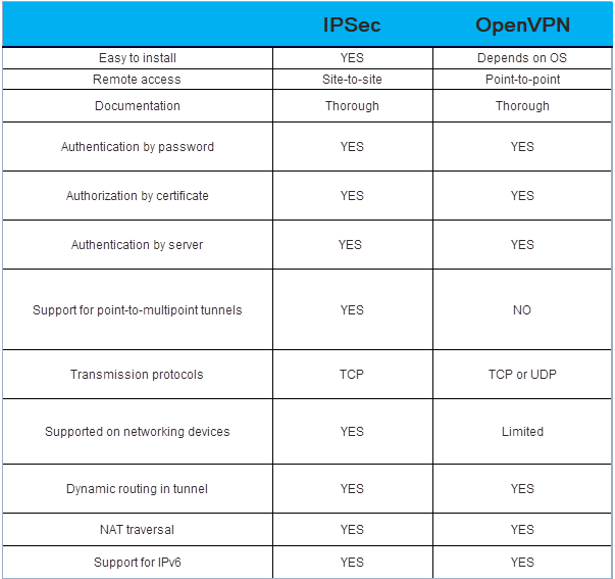
Although both protocols are suitable VPN solutions, OpenVPN is often considered more secure and flexible. IPSec is ideal as an "always on" site-to-site solution, particularly for securing on-premises resources. For IoT, however, it can be more difficult to implement in the field.
Thanks to its on-demand point-to-point nature, OpenVPN is extremely suitable for troubleshooting devices, regardless of their location.
In short: For IoT implementations, the choice between IPSec and OpenVPN depends on the specific needs. Both offer robust security capabilities, but their applications differ significantly.
Do you have any questions or would you like more information? Please feel free to contact us!
Simhuis has in-house professionals with experience in mobile telecom since 1994 and in industrial automation (IoT, M2M, data communication) since 2009! This allows us to provide you with perfect support for any question, anywhere in the world!
Telephone
0575-474731
info@simhuis.nl
Address
Doetinchemseweg 537021 BR Zelhem

